Course Outline▾
General Question - Simple Present — Question

When do we use it?
Asking about habits,
finding out facts,
getting to know someone,
and checking if something is true.
Do you speak English?
Does she work at a hospital?
Where do you live?
What time does the class start?
What is a question?
A question is a sentence that asks for information — and it always ends with a question mark: ?
But how a question is built is very different between Vietnamese and English.
In Vietnamese, a question is mostly about sound and particles (tiểu từ hoặc từ tình thái). You can turn any statement into a question by:
adding à / nhỉ / nhé / hả at the end
wrapping with có … không
using a rising tone when speaking
Bạn học tiếng Anh. → statement Bạn học tiếng Anh à? → question, same word order
The question mark (?) in Vietnamese follows naturally — it appears when the sentence has that rising feeling, but the words themselves don't move.
In English, the question mark alone is not enough.
You must also change the word order and add an auxiliary verb (do / does).
The structure itself signals the question — not the tone, not a particle at the end.
You study English. → statement Do you study English? → question, word order changes
⚠️ This is why Vietnamese learners often write:
❌ You study English?
It feels correct because it works in Vietnamese — but in English, the ? mark alone does not make a question. The grammar must change too.
How do we form it?
There are two types: Yes/No questions and Wh- questions.
Yes/No question:
Do / Does + Subject + Verb (base form)?
Wh- question:
Wh- word + Do / Does + Subject + Verb (base form)?
Use Do with: I / You / We / They Use Does with: He / She / It
⚠️ The verb always stays in base form after do/does — never add -s or -es.
Examples
With To Be (no do/does needed):
Am I …?
Am I late?
Are you / we / they …?
Are you ready?
Is he / she / it …? Is she a doctor?
With Regular Verbs — Yes/No:
I / You / We / They Do + verb?
Do you drink coffee?
He / She / It Does + verb?
Does she work here?
With Regular Verbs — Wh-:
What do you …?
What do you do for a living?
Where does she …?
Where does she work?
What time do they …?
What time do they start?
How often does he …?
How often does he exercise?
Short Answers
Question Yes No
Do you …?
Yes, I do.
No, I don't.
Does she …?
Yes, she does.
No, she doesn't.
Are you …?
Yes, I am.
No, I'm not.
Is he …?
Yes, he is.
No, he isn't.
🇻🇳 Vietnamese vs English — Why questions feel different
In Vietnamese, the word order never changes. You simply wrap the sentence with particles or add a question word in place:
Bạn có học tiếng Anh không? (Yes/No)
Bạn học tiếng Anh ở đâu? (Wh-)
In English, the word order changes every time. The auxiliary verb do/does moves to the front:
Do you study English? Where do you study English?
Side by side:
Vietnamese | English | |
|---|---|---|
Word order changes? | No | Yes |
Need auxiliary verb? | No | do / does |
Yes/No marker | có … không | do/does at front |
Question word position | in place (middle or end) | always at front |
Rising tone = question? | Yes | Not enough |
⚠️ The most common mistake Vietnamese learners make:
❌ She works here? ❌ You like coffee?
In English, these sound like surprised reactions — not real questions. The fix is always the same: flip do/does to the front.
✅ Does she work here? ✅ Do you like coffee?
Real-life sentences
Do you wake up early every day?
Does your sister live in Ho Chi Minh City?
What time does your class start?
Where do you work?
Does this café open at 7am?
How often do you practice English?
Practice
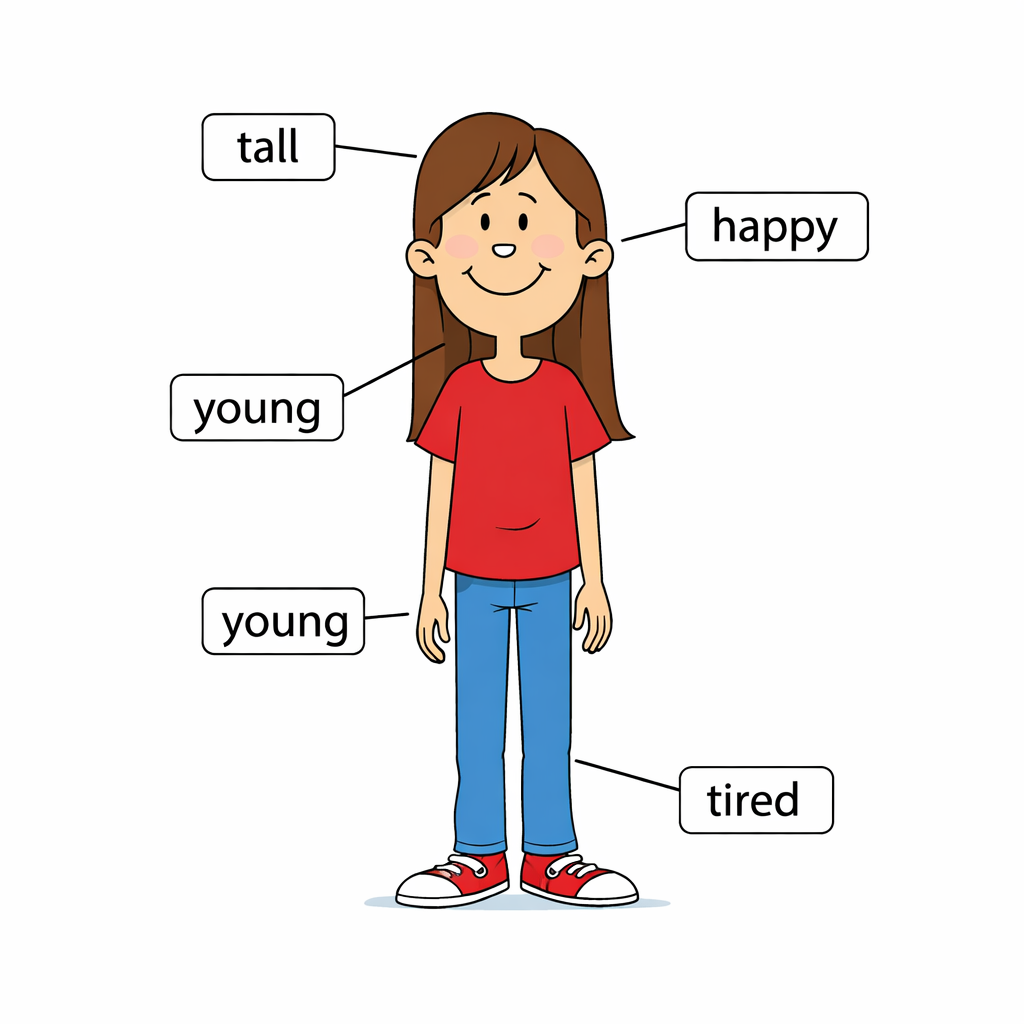
we will play a game , look at picture then your job will think what will we ask her.
Example: Tall,
You: Is She Tall -> Correct.
Sample
Click show Sample
Here are the answers for Level 1 (Yes/No questions):
Is she tall?
Is she happy?
Is she young?
Is she tired?
Cool move next to Immediate level
Show Sample
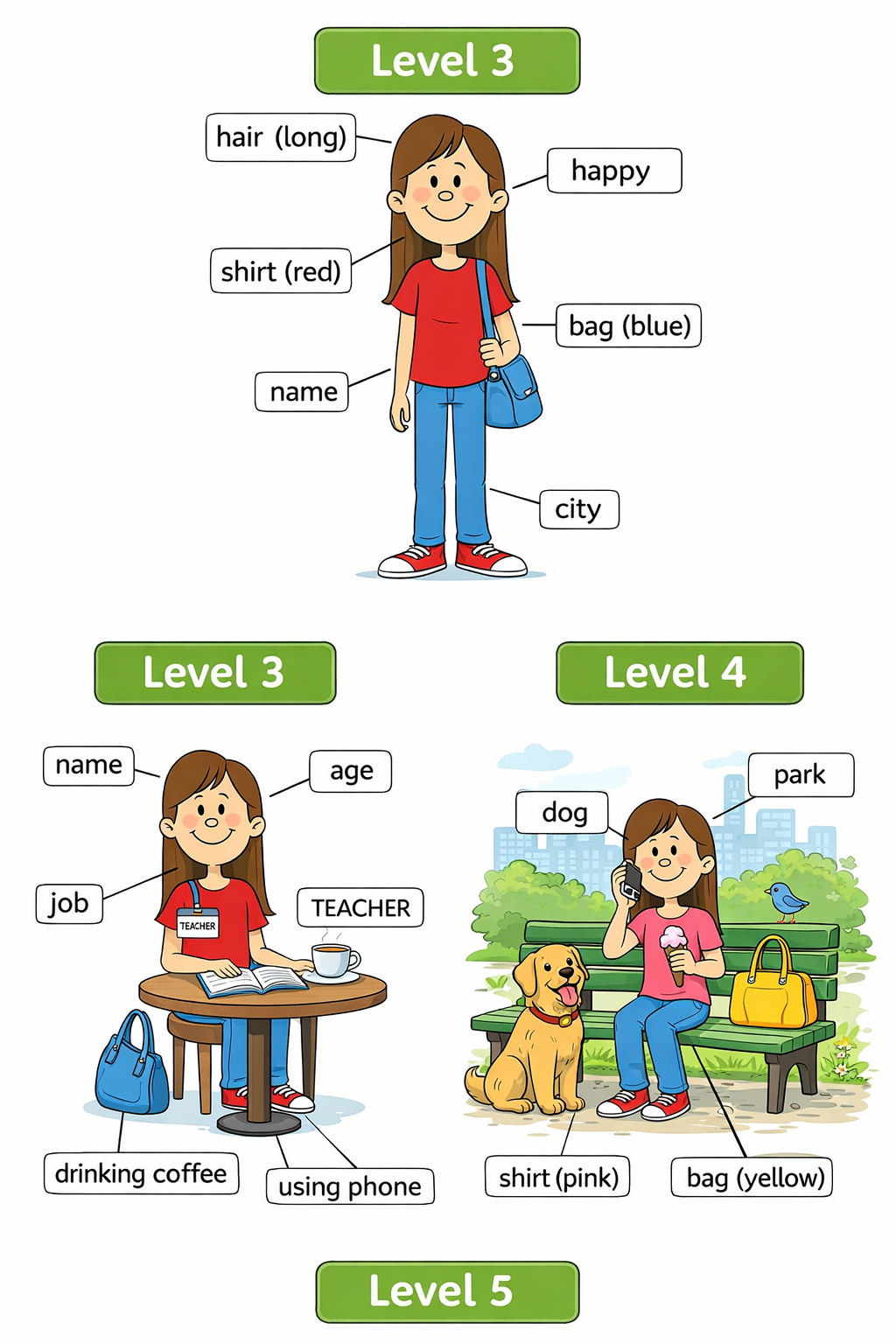
🔹 Level 2 (Basic: noun + adjective)
Is her hair long? — Yes, it is.
What color is her shirt? — It is red.
Is her bag blue? — Yes, it is.
🔹 Level 3 (Wh- questions)
What is her name? — Her name is Anna.
How old is she? — She is 20 years old.
What is her job? — She is a teacher.
Where does she live? — She lives in a city.
🔹 Level 4 (Actions – Present Continuous)
What is she doing? — She is drinking coffee.
Is she using her phone? — Yes, she is.
Is she reading? — No, she isn’t.
Where is she? — She is in the park.
What is she doing? — She is eating ice cream.
Does she have a dog? — Yes, she does.
What color is her shirt? — It is pink.
Is her bag yellow? — Yes, it is.
Great we move to outside world.
Check it out
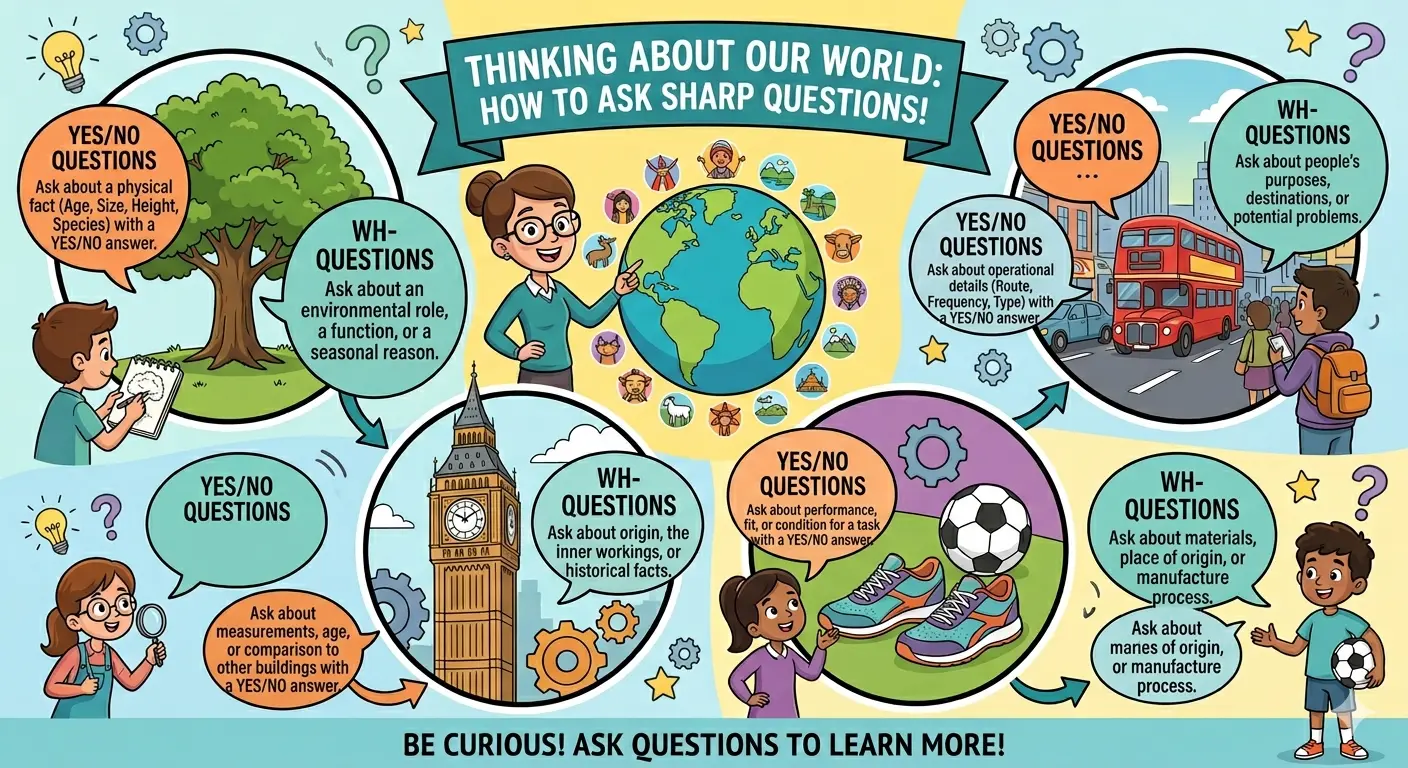
🌳 Tree / Nature
YES/NO Questions (physical facts)
Is this tree over 100 years old?
Is this an oak tree?
Is the tree taller than 10 meters?
WH- Questions (role, function, season)
Why do trees lose their leaves in autumn?
What role does this tree play in the ecosystem?
When does this tree produce fruit?
🏛️ Big Ben / Building
YES/NO Questions (measurements, age, comparison)
Is Big Ben taller than the Eiffel Tower?
Is this building more than 150 years old?
WH- Questions (origin, inner workings, history)
Where was the clock mechanism made?
How does the bell inside work?
Why was Big Ben built in that location?
🚌 Bus / Transportation
YES/NO Questions (route, frequency, type)
Does this bus run on weekends?
Is this bus an electric vehicle?
WH- Questions (purpose, destination, problems)
Where is this bus going?
Why do people prefer buses over taxis?
What problems can cause a bus to be late?
⚽ Shoes / Sports
YES/NO Questions (performance, fit, condition)
Are these shoes suitable for running on wet grass?
Do these shoes fit properly?
WH- Questions (materials, origin, manufacture)
What material is the sole made of?
Where are these shoes manufactured?
How are the shoes tested before selling?
Lesson 4 of 9