Course Outline▾
Simple Present — Positive

When do we use it?
Talking about yourself,
introducing what you do for a living,
describing habits,
describing things,
and stating facts.
Hi, my name is Peter. I like learning English.
I practice English every day and try to improve a little more each day.
That house is really beautiful — it has an enormous door and is a very famous place in Vietnam.
The Earth revolves around the Sun. Water boils at 100 degrees Celsius.
How can we apply it?
Simple Present is a tense, built from 2 main elements:
Subject + Verb
The Subject can be a noun or pronoun (I, You, He, She, We, They, Peter...) The Verb can be To Be (am / is / are) or a regular verb (go, run, sleep, learn...)
⚠️ Remember: when the subject is He / She / It — add -s or -es to the verb.
Examples
With To Be:
I am I am a teacher.
You / We / They are You are late. We are ready.
He / She / It is She is a doctor. It is cold today.
With Regular Verbs:
I / You / We / They base form I work from home. They study every night.
He / She / It verb + s/es He works from home. She watches the news.
Real-life sentences:
I wake up at 6am every morning.
My sister works at a hospital in Hanoi.
He speaks three languages.
We eat dinner together as a family.
The sun rises in the east.
This coffee shop opens at 7am.
Practice - tell about your daily activities.
Vocabular first.

As you already know the vocabulary, right now please do it by yourself.
Fill in the activities in the image below:
Look at the first image. The word is: UP
You will:
GET UP ✓ → correct, next …
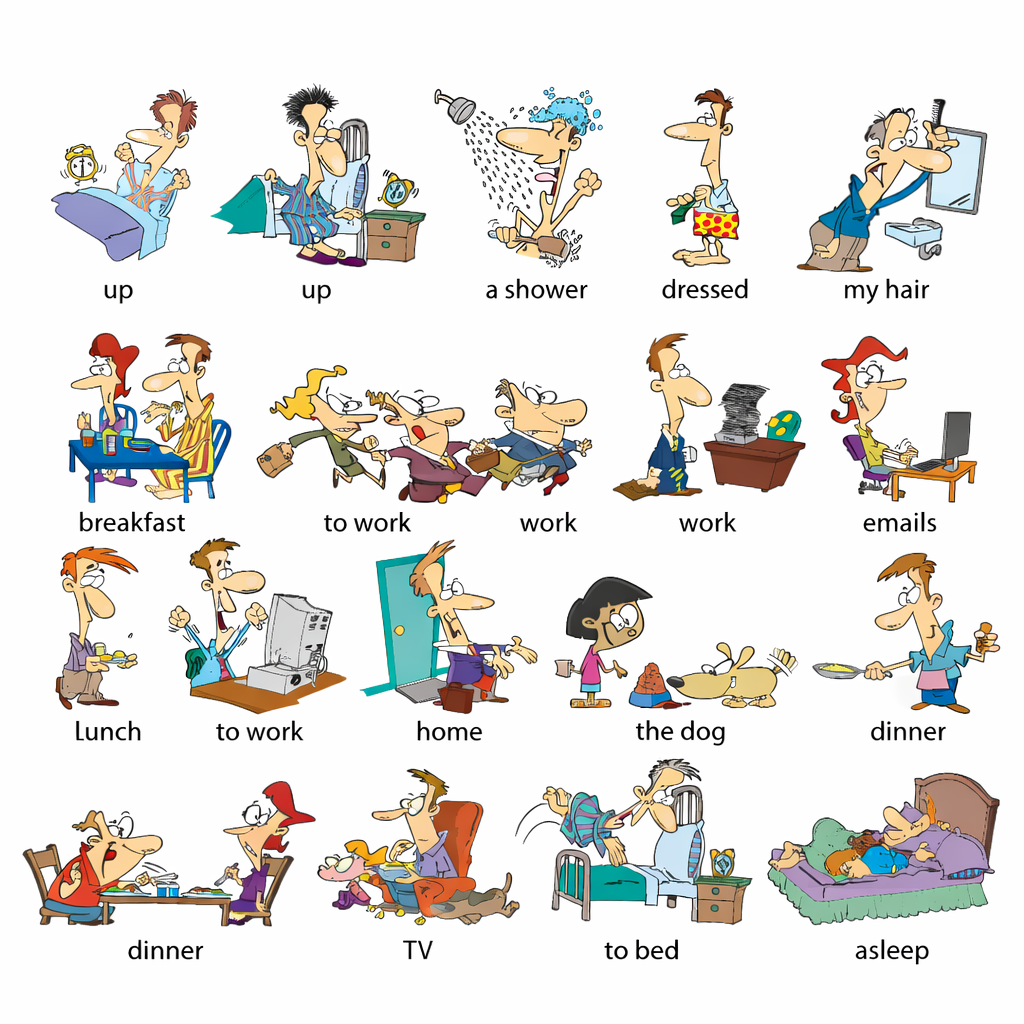
Sample Anwser without correct order :)
answer, arrive, comb, cook, fall asleep, feed, finish, get dressed, get up, go, have, start, take, wake up, watch
Lesson 2 of 9